







- Home
- What's new at FocalScope
- Productivity
A practical guide to eliminating the friction that quietly costs your team hours every week.

Most support leaders look at their dashboards and see a functioning operation. Tickets are closing. Customers are getting responses. The numbers are not alarming.
But dashboards measure outcomes. They don’t measure what happens in between.
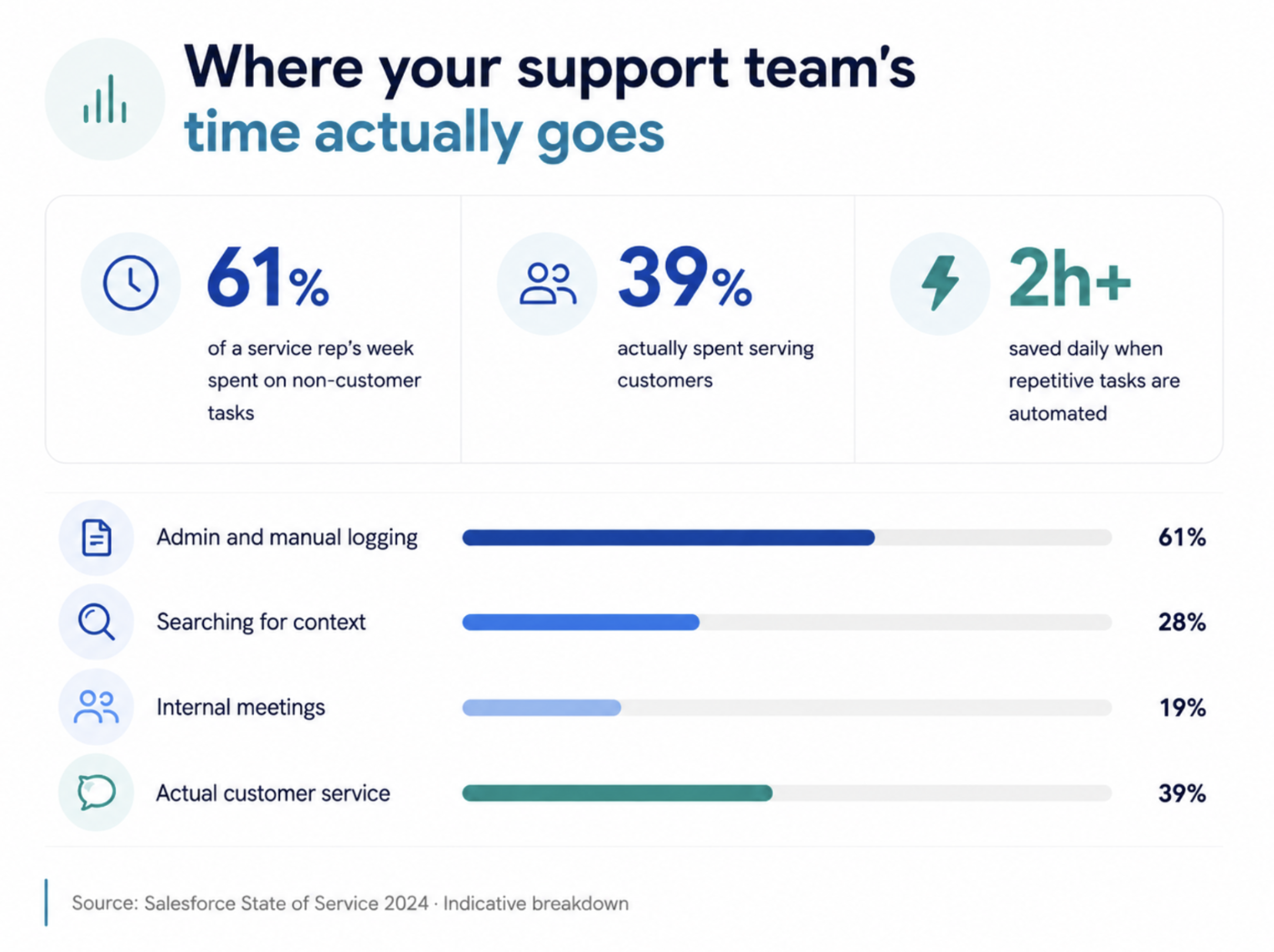
Research now shows that barely four in ten working hours are spent actually serving customers.
The rest disappears into admin, manual logging, context-searching, and internal coordination that produces nothing a client would ever notice or value. For a team of ten, that is six people’s effort going nowhere, every single day.
The problem is not that your team is not working hard.
The problem is that a significant portion of that hard work is going nowhere.
The Hidden Work Inside Every Support Interaction
It is not one obvious bottleneck. It is dozens of small frictions, embedded so deeply into daily operations that most teams have stopped noticing them.
It looks like this: switching between three systems to gather context before responding to a single conversation. Manually assigning tickets because routing rules are outdated or were never configured. Rewriting the same response, slightly differently, for the tenth time that week.
Copying customer information from one platform to another. Searching across disconnected channels for a previous interaction that should be immediately visible.
Each of these tasks takes minutes. Some take seconds. None of them appear significant in isolation.
At scale, across every shift, every team member, and every customer interaction, they form a structural drain on capacity that compounds continuously and silently.
Not a dramatic failure. A quiet, permanent one.
Why It Stays Invisible
The reason this inefficiency persists for so long in most teams is straightforward: it doesn’t break anything.
Customers still receive replies. Tickets still close. SLA reports still go out. Everything appears functional, which means there is no obvious trigger to investigate further.
What is missing is visibility into the work that sits inside each resolved ticket. A twelve-minute interaction might contain three minutes of actual problem-solving and nine minutes of system navigation, manual updates, and internal coordination. That nine minutes does not appear anywhere in your reporting. It is not a KPI. It is simply accepted as part of how things work.
Over time, teams normalise it. Processes are designed around it. Headcount increases to compensate for it. And the underlying inefficiency continues to grow alongside demand.
The Compounding Cost
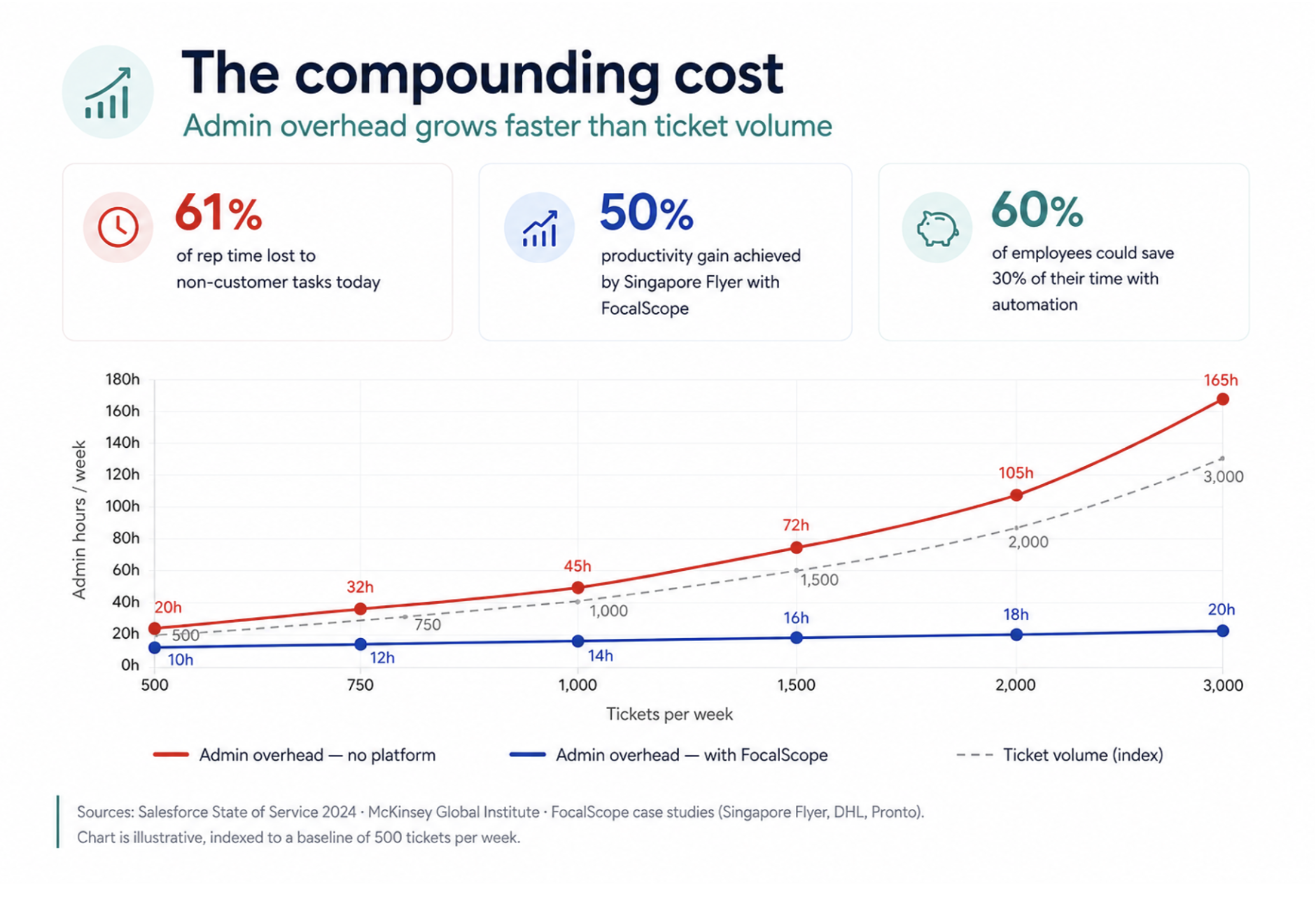
Manual effort does not scale gracefully. Every new channel, every new team member, and every new layer of operational complexity adds incremental friction.
More conversations entering from more channels means more manual routing. More internal stakeholders means more coordination overhead. More growth means more data to retrieve, reconcile, and update across disconnected systems.
Without a unified structure, each of these compounds into a support environment where your team spends more time managing work than doing it.
The cost is not just operational. Customers experience it directly.
When manual processes slow your team down, response times increase. Resolution takes longer. Customers are asked to repeat information they have already provided. Consistency drops across channels because context is fragmented and individual agents fill the gaps differently.
In a competitive environment, these are not minor service variations. They directly affect renewal rates, retention, and how clients talk about you.
Where the Time Actually Goes
Across different industries and team structures, the same categories of manual work appear repeatedly.
- Ticket routing and triage. Without intelligent automation, incoming conversations rely on human judgment to reach the right person. This introduces delays at the very first step of every interaction.
- Repetitive responses. Common queries are answered from scratch, repeatedly, throughout the day. Without structured templates accessible to the whole team, quality and consistency vary by individual.
- Fragmented context retrieval. Customer history sits across multiple systems. Before your team can respond effectively, they need to locate, retrieve, and assemble information that should be available immediately.
- Manual reporting. In many operations, performance data still requires human extraction and consolidation. The result is reporting that is always slightly behind and always slightly incomplete.
Each of these consumes time that your team could spend on the work that actually requires human judgement.
What Recovering That Time Changes
When manual friction is removed, the effects are immediate and measurable.
Capacity increases without additional headcount. Response times improve because attention goes to resolution rather than administration. Consistency improves because structured workflows replace individual improvisation. Team performance improves because people are doing work that uses their skills rather than tests their patience.
The strategic shift matters as much as the operational one. Leadership regains control over scaling. Instead of adding headcount to absorb inefficiency, it becomes possible to focus on service quality, channel expansion, and customer experience.
Efficiency stops being a cost pressure and becomes a growth lever.
Why FocalScope Solves This Better
Most platforms add features on top of fragmented workflows. FocalScope eliminates fragmentation from the foundation.
Unlike helpdesks that treat email as one channel among many, FocalScope treats email as the core and unifies everything around it. Unlike tools that require manual routing setup and constant tuning, FocalScope’s routing learns from your actual ticket patterns and improves automatically. Unlike platforms that charge extra for reporting and dashboards, FocalScope includes 70+ built-in reports and real-time dashboards across every subscription tier.
The difference is not small. It is the difference between optimising a broken system and replacing it with a structured one.
How FocalScope Fixes It
This problem is not solved by a single feature. It is solved by removing fragmentation across the entire support operation.
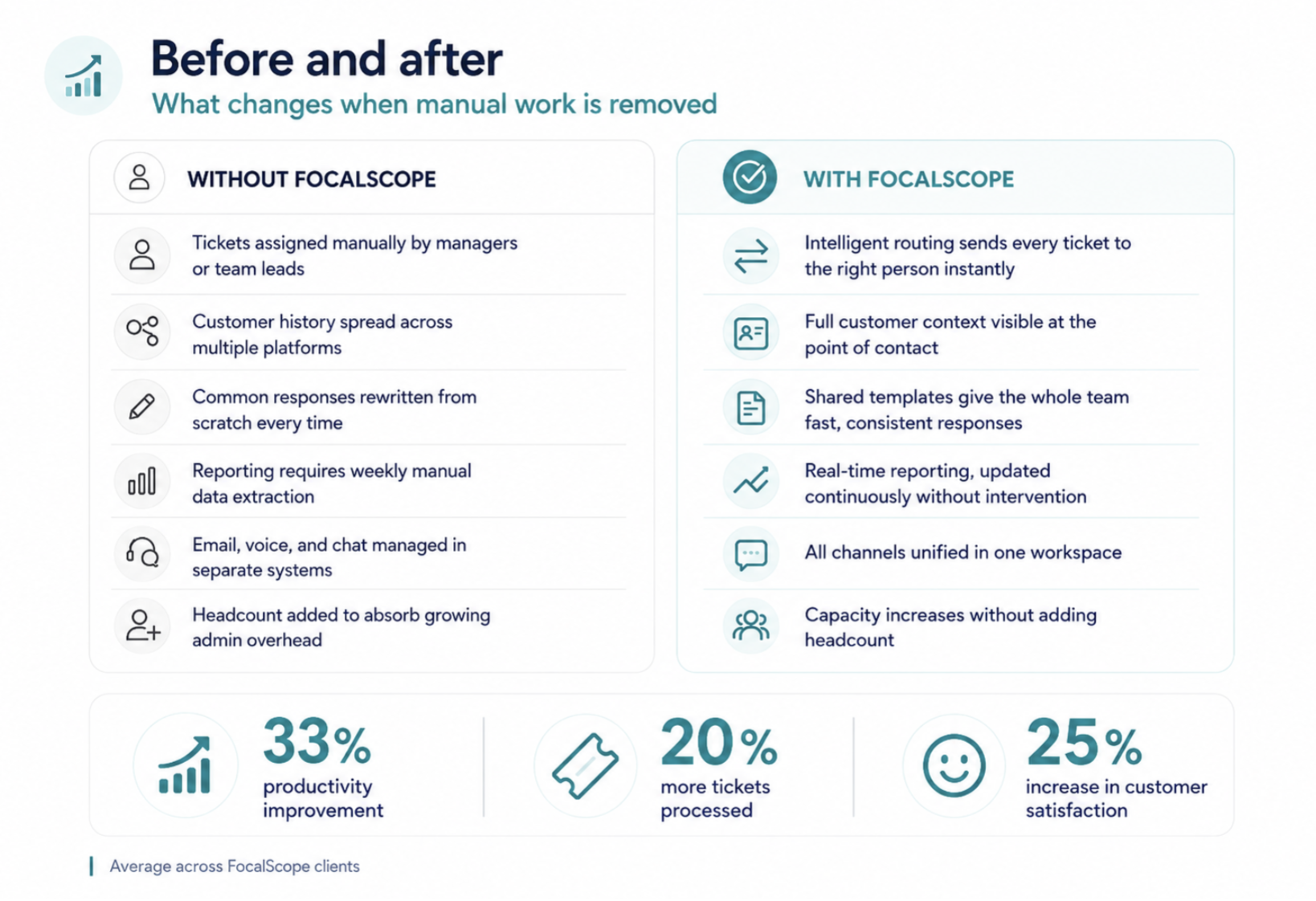
FocalScope consolidates every customer conversation, email, live chat, WhatsApp, social media, voice, into one unified inbox. Your team never switches platforms to manage a single interaction.
Intelligent routing eliminates manual triage. When a message arrives, FocalScope automatically routes it to the right person based on skills, availability, VIP status, and urgency. No manager reads every email first. No tickets sit in a queue waiting for human judgment. They flow directly to resolution.
Every agent has complete customer context instantly. Before responding, your team sees the full customer history, all previous tickets, account details, preferences, notes from colleagues. No searching across disconnected systems. No asking customers to repeat themselves. Context is there by default.
Structured responses replace repetition. Common questions are answered using pre-approved templates. AI assists with reply suggestions, pulling from your customer’s history and interaction patterns. Agents spend time solving problems, not drafting from scratch.
Real-time reporting replaces manual data work. No more spreadsheet consolidation. No more reports that lag by a day. Managers see live performance data: queue status, SLA risk, response times, channel volume. They manage proactively instead of reactively.
The result is not just faster support. It is structurally simpler support that scales without adding proportional complexity or headcount.
What This Delivers: Real Results
FocalScope customers report consistent, measurable improvements within 30 days:
- 33% average productivity improvement from consolidated workflows, automated routing, and AI-assisted replies. That is three hours of recovered capacity per agent per week.
- 25% increase in customer satisfaction because customers experience faster responses, more accurate information, and never repeat themselves
- 20% more tickets processed without additional headcount. The same team handles significantly higher volume.
These results come from teams in travel, logistics, retail, hospitality, and financial services. The pattern is consistent: once manual friction is removed, capacity increases immediately.
This is not a long-term promise. It is what happens in the first month.
A Practical Question to Ask Your Team
If you asked your team today how much of their working time goes into tasks that do not directly help a customer, most would have an answer ready. They experience it constantly. They have simply stopped raising it because no one asked, or because previous tools promised to fix it and did not.
The most useful exercise is to take one typical day of ticket volume and estimate honestly what proportion of each interaction is administrative rather than resolutive. Then multiply across your team size and weekly volume.
In most cases, the number is significant enough to reframe how the entire operation should be structured.
This is a design issue. And design issues can be fixed.
The Competitive Case for Getting This Right
Customer support has become one of the most visible parts of the client relationship. Every slow response, every repeated question, every inconsistent answer lands directly on the customer. There is nowhere for operational friction to hide.
Businesses that remove that friction respond faster, scale more cleanly, and deliver experiences that feel effortless, without adding cost or headcount to do it. Those that do not will keep growing complexity alongside demand, hiring to absorb inefficiency rather than to improve service.
The teams pulling ahead are not necessarily larger or better resourced. They are better structured. Every hour recovered from unnecessary administration goes back into the work that actually keeps clients.
That is not a process improvement. That is a competitive advantage.
The next step
Every hour your team spends on admin is an hour a customer doesn’t get. Schedule a 30-minute walkthrough and we’ll show you exactly where that time is going and how to get it back. Most teams see results faster than they expect.
Related Topics


Custom Wiki Knowledgebase

Call Routing &
SLA Customisations