- Home
- What's new at FocalScope
- Cloud vs on-premise contact center
Choosing between cloud and on-premise contact center software used to be a cost decision. For EU organisations, it is now a compliance one.

For EU organisations, that decision is now more complicated. GDPR, the EU Data Act, and growing concern about US cloud infrastructure mean that where your customer data lives, and who controls it, are compliance questions. Not just technical ones.
This guide explains the difference between cloud and on-premise contact center software, what EU compliance requires of each, and how to decide which is right for your organisation.
Cloud vs on-premise contact center software: what is the difference?
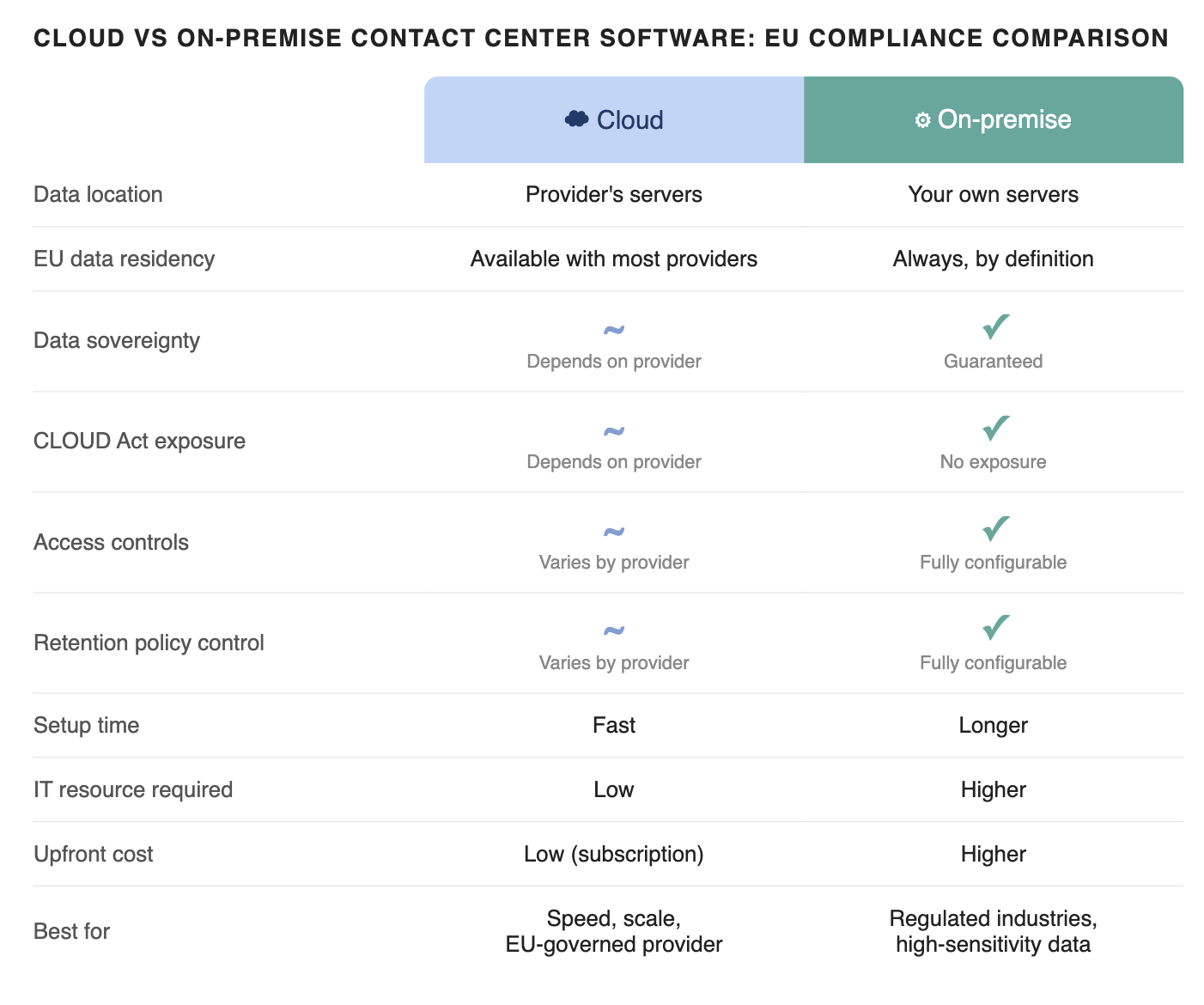
Cloud contact center software runs on servers managed by your provider. You access it through a browser or app. Your provider handles infrastructure, security updates, and maintenance. Setup is fast. Costs are typically subscription-based. You don’t need a large internal IT team to run it.
On-premise contact center software runs on servers inside your own organisation. Your IT team manages the infrastructure. Data stays within your own environment. Setup takes longer and requires more internal resource. But you have direct control over everything: where data is stored, who can access it, and how it is managed.
For most of the last decade, cloud won this comparison easily. Lower upfront cost, faster deployment, and less IT overhead made it the obvious choice for growing support teams.
EU compliance has changed the calculation.
Is cloud contact center software GDPR compliant?
The short answer is: it depends on the provider.
GDPR requires that your organisation can demonstrate control over customer personal data. You must be able to show where it is stored, who has access, how long it is kept, and how you would respond if a customer or regulator asked questions. The regulation also places strict rules on transferring personal data outside the EU.
Cloud contact center software can meet these requirements. But only if the provider is built to support them. Many are not.
The problem is not cloud as a model. The problem is cloud infrastructure governed by non-EU law.
Data residency vs data sovereignty: why the difference matters
This is one of the most important distinctions in EU compliance, and it is widely misunderstood.
Data residency means your data is stored on servers inside the EU. Many providers offer this. It sounds reassuring. But it does not tell you who governs that data.
A provider can store your data in Germany while operating under rules that allow organisations outside the EU to access it. The most significant example is the US CLOUD Act. This law allows US authorities to demand data from US-owned companies, including data stored in Europe. If your contact center software is owned by a US company, an EU server location does not fully protect your data.
Data sovereignty means your data is governed by EU law. Not just stored in the EU. It means no one outside your agreed framework can access your data without your knowledge. Access is controlled, documented, and auditable. You can prove this to a regulator if required.
Data residency is where your data is. Data sovereignty is who controls it.
For EU organisations using cloud contact center software, the critical question is not “are the servers in Europe?” It is “is this provider subject to non-EU legal demands for data access?”
When is on-premise contact center software the right choice?
On-premise contact center software removes this uncertainty entirely. When the software runs on your own servers, in your own facilities, no external party has access unless you choose to grant it. Your IT team controls the infrastructure. Data does not leave your environment.
For some organisations, this level of control is not just preferable. It is required.
Organisations in regulated industries such as financial services, healthcare, and government often have governance requirements that cloud infrastructure can’t satisfy. Organisations handling particularly sensitive customer data, or those subject to strict internal security policies, may reach the same conclusion.
On-premise is also worth considering if your organisation has already experienced a compliance audit, if you operate across multiple jurisdictions with conflicting data rules, or if your legal or data protection team has flagged concern about third-party data access.
The tradeoff is real. On-premise requires more internal IT resource, higher upfront investment, and ongoing maintenance. But for organisations where data control is non-negotiable, it is the right answer.
What EU compliant contact center software needs to provide
Whether you choose cloud or on-premise, there are five things your contact center software must provide to meet EU compliance requirements.
- EU governance, not just EU hosting: Your provider should operate under EU law. That means the company itself, not only the data centre. If the parent company is based outside the EU and subject to non-EU legal demands, EU hosting alone is not sufficient.
- Configurable access controls: Your organisation should decide who can see what. You need to be able to set permissions by role, see a clear log of all access, and remove access immediately when someone leaves or changes role. These controls should be in your hands, not your provider’s.
- Configurable data retention: GDPR requires that personal data is not kept longer than necessary. Your platform should let you set retention rules, automate deletion when records reach their limit, and document your practices clearly.
- Full search and audit capability: When a customer exercises their rights under GDPR, you have one month to respond. Your platform should make it straightforward to locate all records for any individual across every channel and produce them quickly. Every conversation should be searchable.
- Unified channels: If your team handles email in one system, live chat in another, and phone calls somewhere else, you don’t have data governance. You have data fragmentation. A single platform for all channels makes compliance significantly more manageable.
How FocalScope gives EU teams both options
FocalScope is an omnichannel contact center platform built for EU organisations that need real control over their customer data. It brings email, voice, live chat, WhatsApp, and social messaging into one unified workspace, with consistent access controls and data governance across every channel.
For organisations that need EU-governed cloud infrastructure, FocalScope operates under EU regulatory frameworks. Data centre locations, subprocessor relationships, and contractual protections are fully documented. GDPR-aligned Data Processing Agreements are standard.
For organisations that require complete infrastructure control, FocalScope offers on-premise deployment. The platform runs entirely on your own servers. No data leaves your environment. Your IT team manages everything directly.
Most contact center software providers offer one or the other. FocalScope offers both, and the decision about which is right for your organisation is one you make based on your compliance requirements, not your provider’s limitations.
Access controls are fully configurable. Data retention policies are yours to set and document. Every conversation is searchable across every channel. And if a regulator asks questions, you have a single source of truth to answer them.
What about a hybrid contact center deployment?
Some organisations don’t need to choose between cloud and on-premise. A hybrid deployment lets you run parts of your contact center software on your own servers while keeping other functions in the cloud. Sensitive customer data stays within your own infrastructure. Less critical functions, such as reporting or team management tools, can run in the cloud where it is more convenient.
FocalScope supports hybrid deployment, giving your organisation the flexibility to match your infrastructure to your compliance requirements, rather than the other way around. You can find more detail on deployment options at focalscope.com.
Making the right decision for your organisation
Cloud contact center software is not inherently non-compliant. On-premise is not right for everyone. The right answer depends on your industry, the sensitivity of your customer data, your internal IT capability, and your specific governance requirements.
What is not optional is the compliance itself. GDPR obligations apply regardless of which deployment model you choose. The question is whether your platform makes it straightforward to meet them.
Start by asking your current or prospective provider four questions. Where exactly is our data stored and under which legal framework? Who can access it and can we control that? Can we set our own retention policies? And do you offer on-premise deployment if our requirements change?
If the answers are clear, documented, and specific, you are talking to a provider that takes compliance seriously. If they are vague, that is important information.
What to do next
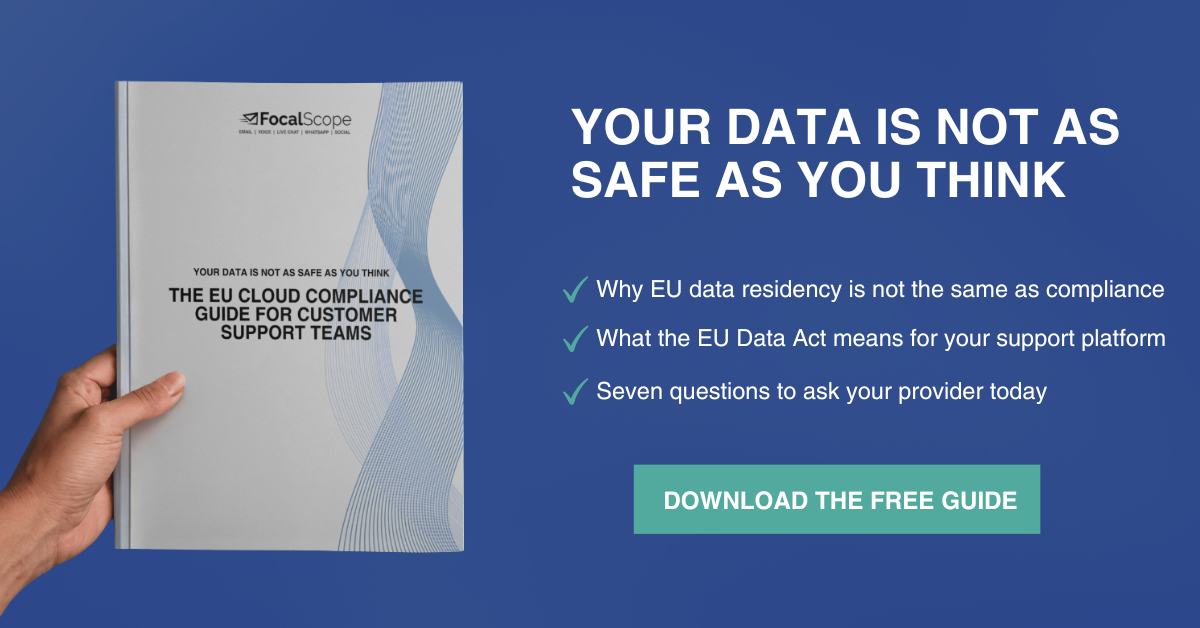
Not sure whether cloud or on-premise is the right fit for your compliance requirements? Download our complete guide: EU Cloud Sovereignty for Customer Support: How to Stay Compliant and Take Control.
Or book a call with our team. We work with support operations managers navigating exactly this decision. Bring your questions, your current setup, and your compliance requirements. We will give you a straight answer on where you stand.
Related Topics


Custom Wiki Knowledgebase

Call Routing &
SLA Customisations